


Anatomy of a Budgie: A Complete Guide to Budgie Body Parts, Organs and Feather Structure
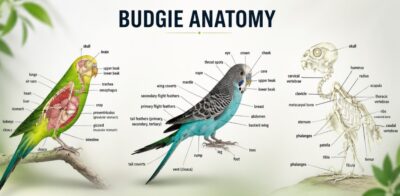
Anatomy of a Budgie: A Complete Guide to Budgie Body Parts, Organs and Feather Structure
If you own a budgie, or you’re considering welcoming one into your home, understanding the anatomy of a budgie is one of the best ways to provide excellent care. Every part of a budgie’s body has evolved for survival, from its lightweight skeleton and powerful flight muscles to its uniquely shaped feet and highly efficient respiratory system.
Although budgies are among the smallest members of the parrot family, they possess remarkably advanced anatomy. Their bodies are perfectly designed for speed, agility and endurance, allowing them to travel long distances in the wild while remaining alert to predators. Furthermore, each anatomical feature plays an important role in keeping them healthy, active and happy.
In this guide, we’ll explore the anatomy of a budgie, including its external body parts, internal organs, feather structure, skeletal system and fascinating biological adaptations. By the end, you’ll have a much better understanding of how these intelligent little birds function and why proper care is so important.
What Is the Anatomy of a Budgie?
The anatomy of a budgie refers to the complete structure of the bird’s body, both inside and out. It includes visible features such as the beak, wings, tail and feet, along with internal systems like the heart, lungs, digestive tract, muscles and skeleton.
Unlike mammals, budgies have evolved specifically for flight. Consequently, nearly every bone, muscle and organ has adapted to reduce weight while maximising strength and efficiency. Their lightweight frame, specialised feathers and unique respiratory system work together to make budgies exceptional flyers.
Understanding budgie anatomy not only satisfies curiosity but also helps owners identify injuries, detect illness earlier and create an environment that supports natural behaviours.
External Anatomy of a Budgie
Head Anatomy
The head contains many of the budgie’s most important sensory organs.
The eyes sit on either side of the head, providing an incredibly wide field of vision. As prey animals, budgies must constantly scan their surroundings for danger. Their eyesight is exceptionally sharp, and they can even see ultraviolet (UV) light, allowing them to recognise feather patterns and food sources that humans cannot detect.
Hidden beneath the feathers are the ear openings. Although invisible at first glance, budgies have excellent hearing and quickly learn to recognise familiar voices, whistles and sounds.
Meanwhile, the neck contains numerous vertebrae, allowing the bird to rotate its head almost 180 degrees. This flexibility makes grooming easier and helps the bird stay aware of its surroundings.
The Budgie Beak and Cere
One of the most recognisable parts of budgie anatomy is the beak.
Unlike teeth, the beak continuously grows throughout the bird’s life. It consists of keratin, the same protein found in human fingernails. Budgies naturally wear down their beaks by chewing wood, climbing and cracking seeds.
Above the beak sits the cere, a fleshy area surrounding the nostrils. Interestingly, the cere often changes colour depending on age, breeding condition and sex. Adult males typically develop a bright blue cere, while females usually display white, tan or brown colouring.
The beak serves many purposes, including:
- Cracking seeds
- Climbing branches
- Holding food
- Preening feathers
- Exploring objects
- Defending themselves when necessary
Budgie Eyes and Vision
Budgies rely heavily on their eyesight.
In fact, vision is their primary sense. Their large eyes allow them to detect movement from almost every direction, reducing the risk of surprise attacks in the wild.
Additionally, budgies perceive colours differently from humans because they can see ultraviolet light. This ability helps them identify healthy mates, locate food and communicate through feather markings that are invisible to us.
Wing Anatomy and Flight Feathers
Flight defines the anatomy of a budgie.
Each wing contains several specialised feather groups, including:
- Primary feathers
- Secondary feathers
- Coverts
- Alula feathers
The primary feathers provide propulsion, while the secondary feathers generate lift. Coverts streamline airflow, and the small alula feathers help prevent stalling during slow flight and landing.
Powerful chest muscles attached to the keel bone generate the force needed for flight. Despite weighing only around 30 to 40 grams, budgies can reach impressive speeds and perform rapid aerial manoeuvres.
Tail Anatomy
Although many people overlook the tail, it performs several vital functions.
The long tail feathers improve balance during flight while helping the bird steer and brake. They also assist budgies when climbing and landing on narrow perches.
Healthy tail feathers are essential for maintaining stability, so damaged or missing feathers can noticeably affect a bird’s confidence in flight.
Legs and Feet
Budgies possess zygodactyl feet, a feature shared by parrots.
This means:
- Two toes point forward.
- Two toes point backward.
This arrangement provides exceptional grip, allowing budgies to climb, perch securely and hold food while eating.
Strong tendons automatically tighten around branches when the bird rests. As a result, budgies can sleep without falling from their perch.
Internal Anatomy of a Budgie
Budgie Skeleton
The skeleton forms the framework of the body while remaining incredibly lightweight.
Many bones are hollow, reducing overall weight without sacrificing strength. Several bones are also fused together, creating a rigid yet durable structure capable of withstanding the forces generated during flight.
Perhaps the most important skeletal feature is the large keel bone, located on the breastbone. This prominent ridge provides a massive attachment point for the powerful flight muscles.
Respiratory System
One of the most fascinating aspects of budgie anatomy is the respiratory system.
Unlike mammals, budgies possess relatively small lungs connected to a series of air sacs throughout the body.
Instead of inhaling and exhaling through the same air passages, fresh air continually flows through the lungs in one direction. Consequently, oxygen exchange becomes much more efficient.
This specialised system supports sustained flight while also helping regulate body temperature.
Because their respiratory systems are so efficient, budgies are also extremely sensitive to airborne toxins such as cigarette smoke, aerosol sprays, scented candles and fumes from overheated non-stick cookware.
Digestive System
The digestive tract efficiently extracts nutrients from seeds, vegetables and other foods.
Food travels through several organs:
- Beak
- Esophagus
- Crop
- Proventriculus
- Gizzard
- Small intestine
- Large intestine
- Cloaca
The crop temporarily stores food before digestion begins.
Next, food enters the proventriculus, where digestive enzymes break it down.
It then moves into the muscular gizzard, which grinds food into smaller particles before it passes through the intestines for nutrient absorption.
Finally, waste exits through the cloaca.
Heart and Circulatory System
Budgies have an extremely fast metabolism, which requires an equally efficient circulatory system.
Their four-chambered heart pumps oxygen-rich blood throughout the body, delivering nutrients to muscles, organs and tissues.
A healthy resting heart rate may range from approximately 200 to over 500 beats per minute, depending on activity level and stress.
This rapid circulation supports flight while maintaining the bird’s naturally high body temperature.
Liver and Kidneys
The liver performs hundreds of essential functions.
It processes nutrients, stores energy, removes toxins and produces substances needed for digestion.
Meanwhile, the kidneys filter waste products from the bloodstream while carefully conserving water. This adaptation is particularly important because wild budgies evolved in Australia’s often dry environments.
Reproductive Anatomy
Male and female budgies have different reproductive systems.
Males possess internal testes that enlarge during breeding season.
Females generally have only one fully functioning ovary, usually the left one. This adaptation reduces body weight, making flight easier while still allowing successful reproduction.
Budgie Feather Anatomy Explained
Feathers are among the most remarkable features of budgie anatomy.
A healthy budgie has more than 3,000 feathers, each serving a specific purpose.
Different feather types include:
- Contour feathers
- Flight feathers
- Tail feathers
- Down feathers
- Filoplumes
Contour feathers create the bird’s smooth appearance.
Flight feathers generate lift and propulsion.
Down feathers trap warm air close to the body, providing insulation.
Filoplumes act like tiny sensors, helping the bird monitor feather position during flight.
Regular preening keeps feathers clean, waterproof and correctly aligned. During preening, budgies spread protective oils produced by the uropygial gland near the base of the tail.
Unique Adaptations That Make Budgies Incredible Flyers
Budgies combine several remarkable anatomical adaptations that make them exceptionally agile.
These include:
- Hollow bones
- Powerful breast muscles
- Lightweight body
- Efficient lungs
- Multiple air sacs
- Streamlined feathers
- Long steering tail
- Flexible neck
- Excellent vision
- Strong zygodactyl feet
Together, these adaptations allow budgies to fly long distances while quickly avoiding predators.
How Understanding Budgie Anatomy Helps Owners
Learning about budgie anatomy offers many practical benefits.
For example, owners who understand normal body structure can recognise swelling, abnormal posture, breathing difficulties or feather problems much earlier.
Similarly, understanding the importance of flight muscles encourages owners to provide larger cages, safe flying opportunities and regular exercise.
Knowledge of the digestive system also helps owners select balanced diets rather than relying solely on seed mixes.
Ultimately, understanding anatomy leads to better health, improved welfare and a stronger bond between bird and owner.
Common Health Problems Linked to Budgie Anatomy
Several common health conditions directly affect different parts of a budgie’s anatomy.
These include:
- Overgrown beaks
- Feather plucking
- Broken blood feathers
- Bumblefoot
- Respiratory infections
- Crop impaction
- Fatty liver disease
- Arthritis
- Egg binding in females
Early veterinary attention significantly improves treatment outcomes. Therefore, regular observation of your budgie’s posture, breathing, droppings, appetite and feather condition is essential.
Frequently Asked Questions About Budgie Anatomy
How many bones does a budgie have?
Budgies have approximately 120 bones, many of which are hollow and fused to reduce weight while maintaining strength.
Why do budgies have two toes facing forwards and two backwards?
This zygodactyl foot arrangement gives budgies outstanding grip, making climbing, perching and holding food much easier.
Can budgies regrow damaged feathers?
Yes. Most feathers regrow during the bird’s natural moulting cycle, provided the feather follicle has not been permanently damaged.
Why is a budgie’s respiratory system different?
Budgies have lungs connected to multiple air sacs, allowing continuous airflow and highly efficient oxygen exchange during flight.
What is the cere on a budgie?
The cere is the fleshy area above the beak that surrounds the nostrils. In adult birds, its colour often helps identify the bird’s sex.
Conclusion
The anatomy of a budgie is a remarkable example of nature’s engineering. Every structure, from the curved beak and zygodactyl feet to the lightweight skeleton and highly efficient respiratory system, has evolved to support flight, survival and daily life. Furthermore, understanding both the external and internal anatomy of a budgie enables owners to provide better nutrition, recognise early signs of illness and create an enriching environment where these intelligent birds can thrive.
Whether you’re a first-time owner, an experienced bird enthusiast or simply fascinated by avian biology, learning about budgie anatomy offers valuable insight into one of Australia’s most beloved companion birds. The more you understand how your budgie’s body works, the better equipped you’ll be to support its health, happiness and longevity.
